
Variables and environments
Restorm’s variables live in an environment folder, which can hold several sets of them: one per environment.
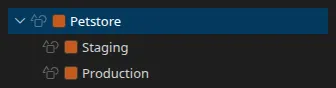
Environments and sub-environments
Section titled “Environments and sub-environments”An environment is a list of key / value pairs. It can contain sub-environments, which inherit from their parent and override whatever they redefine.
That is the right tool for modelling staging → staging / customer A,
staging / customer B: the common base is written once, only the difference is
repeated.
Choosing the active environment
Section titled “Choosing the active environment”The environment picker sits at the left of every request tab’s smartbar. It shows a coloured badge and the environment’s name.
The popover offers an “Apply to all requests” tickbox: when ticked, it
switches the whole folder in one go — which is what you want in order to move an
entire project from local to staging.
Value types
Section titled “Value types”A variable is more than a string. Restorm offers:
| Type | What it is |
|---|---|
| String | A literal value, sent as it is |
| Expression | A Handlebars template — the only type whose {{ }} are evaluated |
| Number | A number, with a display format |
| Boolean | True / false |
| Date time | An ISO date, with a format |
| Color | A hexadecimal colour |
| Secret | A reference to a secret source — the value never passes through the project file |
| List | A list of values |
| Enumeration / Multiple enumeration | A value constrained by an imported enumeration |
| Custom list / Multiple custom list | A choice by label from a custom value list |
| Variable | A reference to another variable |
| Environment | A reference to an environment |
| Null | The explicit null value |
Resolution order
Section titled “Resolution order”From the most general to the most specific — last one wins:
- the root environment, then each sub-environment down the chain;
- the environment’s own variables, in declaration order: a variable can therefore build on the ones defined above it;
- run variables set by a scenario (Set variable action), which cover the environment for the duration of the run;
- the request’s own values (headers, query parameters, path parameters), each group resolving against the accumulated context;
- finally the
{{ }}written directly in the request’s fields — see Inline variables.
Restorm also makes several passes: an expression in a parent environment can therefore pick up a value redefined by a child.
Disabled variables
Section titled “Disabled variables”Every variable has an enable tickbox. A disabled variable does not enter the context — that is the clean way to neutralise an override temporarily without deleting it.
At import time, key / value pairs whose value resolves to empty are disabled automatically: your first run therefore does not fire off a swarm of empty headers.
What about helpers?
Section titled “What about helpers?”Every expression is a Handlebars template, with over a hundred available helpers: strings, maths, dates, lists, encoding, hashing, random data.