
Importing gRPC (.proto or reflection)
Two routes lead to a gRPC tree in Restorm.
From a .proto file
Section titled “From a .proto file”File ▸ Import (Ctrl+I) then the .proto file. Pasted content is recognised
too (the presence of syntax = "proto…", or of a service with rpcs).
| Element | What Restorm makes of it |
|---|---|
Each service | A folder |
Each rpc | A gRPC request |
| The streaming flags | The call type (unary, server-stream, client-stream, bidirectional-stream) |
| The input message | A pre-filled sample message, built from the message’s shape |
| Descriptions and types | The API documentation and the enumerations |
By server reflection
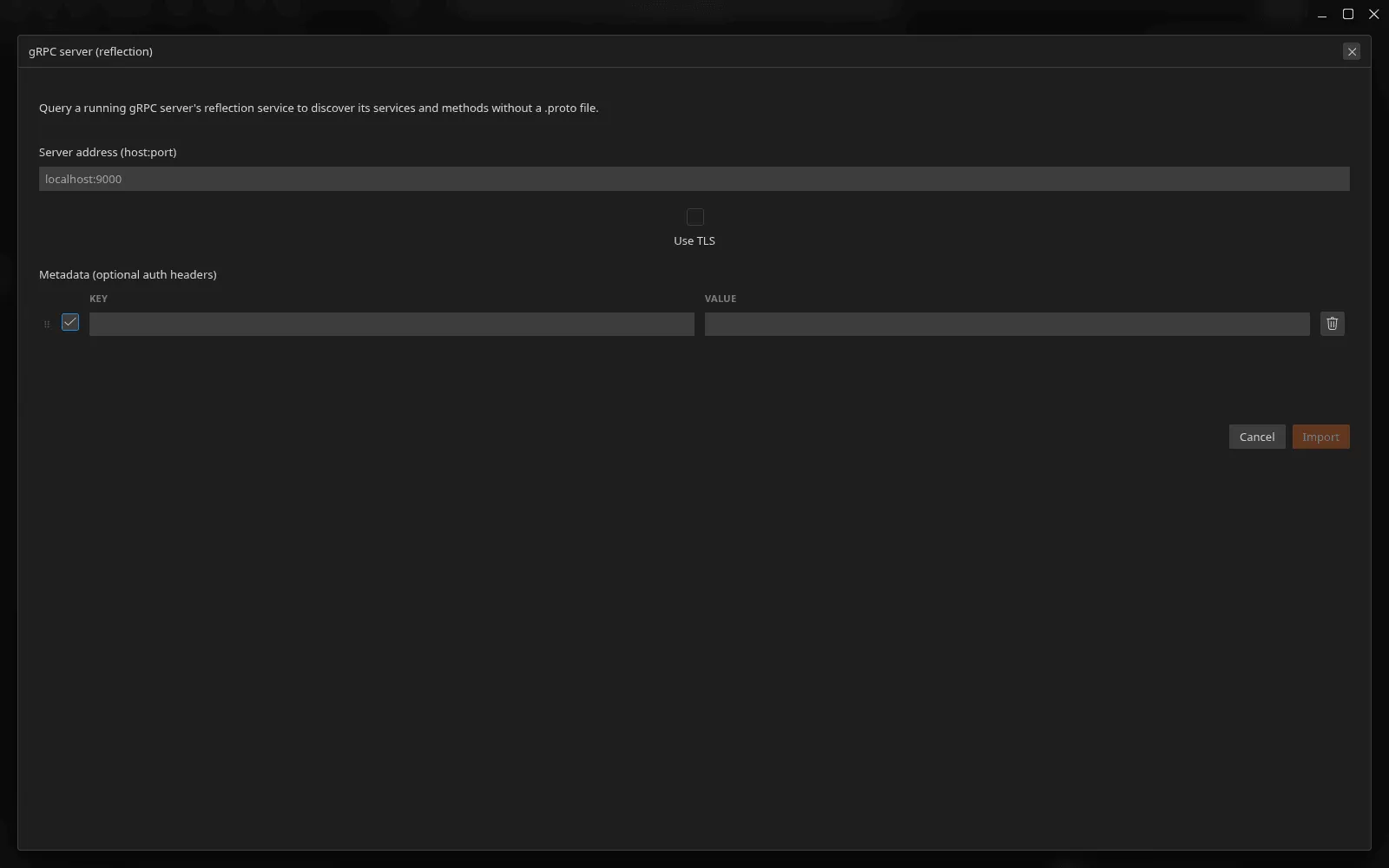
Section titled “By server reflection”From the gRPC import modal, give the host:port address of a running server.
Restorm queries its reflection service and builds the same tree it would from a
.proto.
Two notable advantages:
- It works offline afterwards. The descriptor set obtained is stored on every request created: the calls work even if the reflection server is no longer reachable.
- It can be re-synced. Reconnecting to the same address is recognised as an update of the existing tree, not as a new import. A Refresh from reflection button also exists on the request tab.
If the server does not implement reflection, Restorm says so explicitly: import
the .proto instead.
Updating
Section titled “Updating”gRPC is one of the re-syncable formats, in both modes. See Updating from the source.