
What is Restorm?
Restorm is a desktop application (Windows, macOS, Linux) that brings everything you do around an API into a single project: calling it, mocking it, chaining calls, version-controlling the lot and running it in CI.
A multi-protocol API client
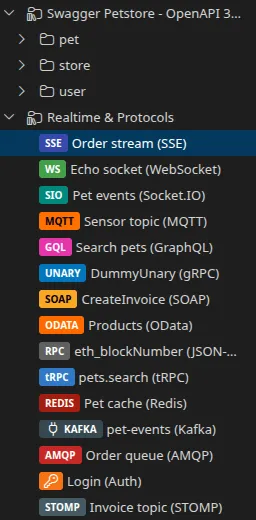
Section titled “A multi-protocol API client”Where most API clients stop at HTTP and GraphQL, Restorm treats fifteen protocols as first-class citizens, each with its own dedicated editor and its own tailored response view:
HTTP · GraphQL · gRPC · SOAP · WebSocket · Socket.IO · MQTT · SSE · STOMP · OData · JSON-RPC (single and batch) · tRPC · Redis · AMQP / RabbitMQ · Kafka.
In practice: the same project can hold the REST call that creates an order, the MQTT subscription that receives the acknowledgement, and the Kafka request that checks the event really was published. See the protocol catalogue.
A mock server
Section titled “A mock server”Restorm can also host a service instead of calling it. You create a
server — a fully fledged item in the tree, added from Add ▸ HTTP server
(or GraphQL, gRPC, SOAP, WebSocket, Socket.IO, MQTT, OData) — you give it a route
and a response, and Restorm listens on localhost. No third-party service, no
network round trip, and {{variables}} are resolved at serving time.
See Server mode.
Visual scenarios
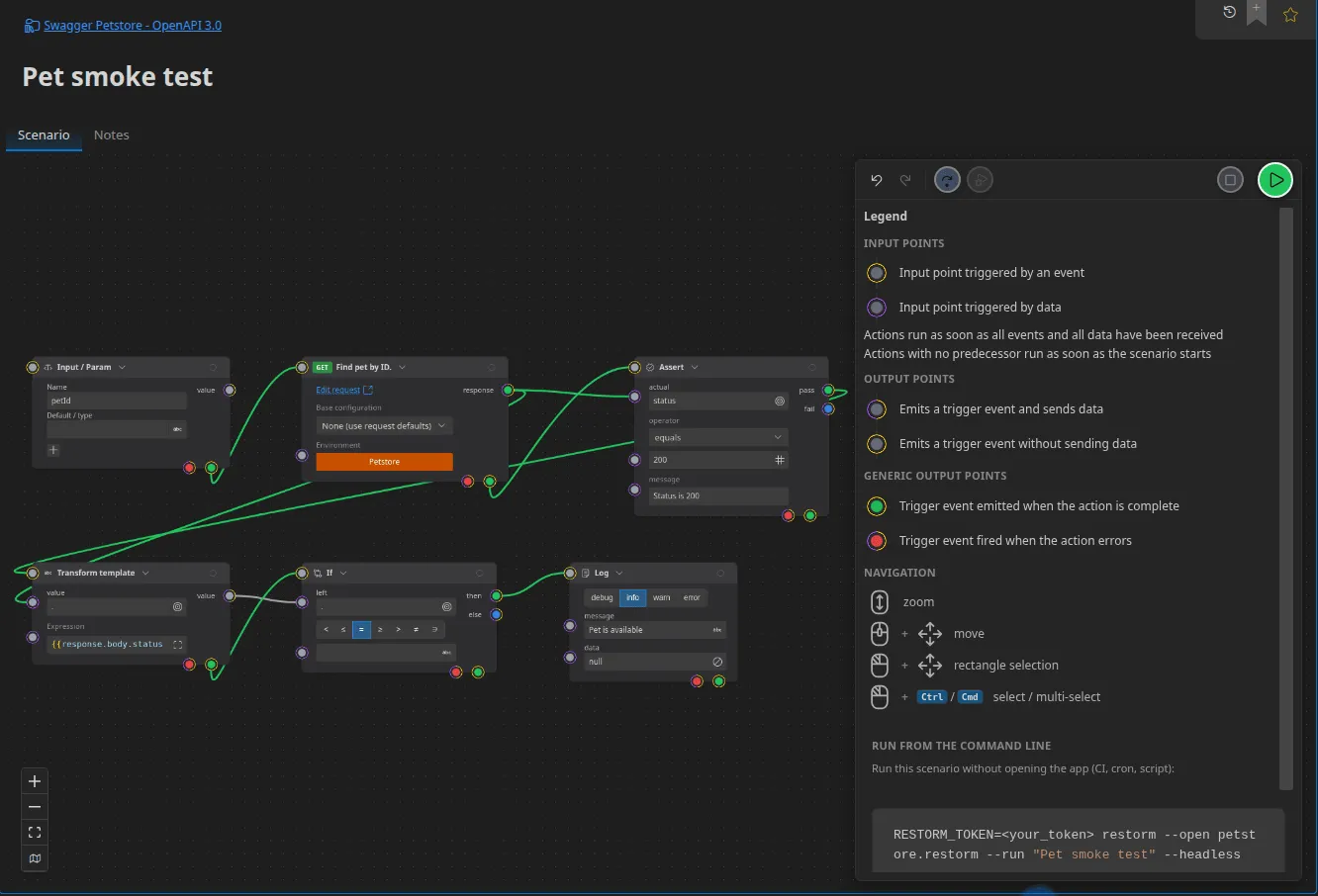
Section titled “Visual scenarios”A scenario is a graph: boxes (call a request, test a condition, loop, transform a value, run code) joined by links that carry values. This is what replaces the pre/post-request scripts of other tools, while staying readable.
Ninety box types are available, from a plain If to a Kafka connection by way of
JSON schema validation. See Scenarios.
Local, file-based, version-controllable
Section titled “Local, file-based, version-controllable”A Restorm project is a .restorm file (YAML by default) or a directory
tree on your disk. Nothing is stored on our side. Serialisation is
deterministic — canonical key order, stably derived identifiers — so that saving
without changing anything produces no diff at all, and so that code review on an
API project is actually workable.
Restorm also ships a git client that understands the format: a commit message generated per entity, and conflict resolution that shows both versions in their genuine editor.
Automatable
Section titled “Automatable”Two automation surfaces:
- the command line:
restorm --open projet.restorm --run "Smoke tests" --headlessruns a scenario with no window, writes the log to standard output and returns an exit code you can use in CI. See Headless execution & CI; - the built-in MCP server: an AI agent (Claude Code, Cursor…) can read the project tree, create requests, run them and drive the interface. See Driving Restorm over MCP.
What about the network?
Section titled “What about the network?”Restorm includes an application firewall: every outbound call that does not come from a URL present in your project is blocked by default and you are asked to authorise it. A dependency phoning home cannot do so without your knowing. See Firewall.
Editions
Section titled “Editions”Restorm is free to use, with no limit on requests or projects, and every execution protocol is included in the Community edition. The Pro and Enterprise editions unlock capabilities (headless execution in CI, built-in git, advanced MCP tools, SSO…) — never quotas. See Plans and capabilities.