
Importing an API
Restorm recognises twenty-four formats and rebuilds a complete project tree from them: folders, requests, environments, API documentation, enumerations.
It is nearly always the best starting point: do not write your requests by hand if a specification exists.
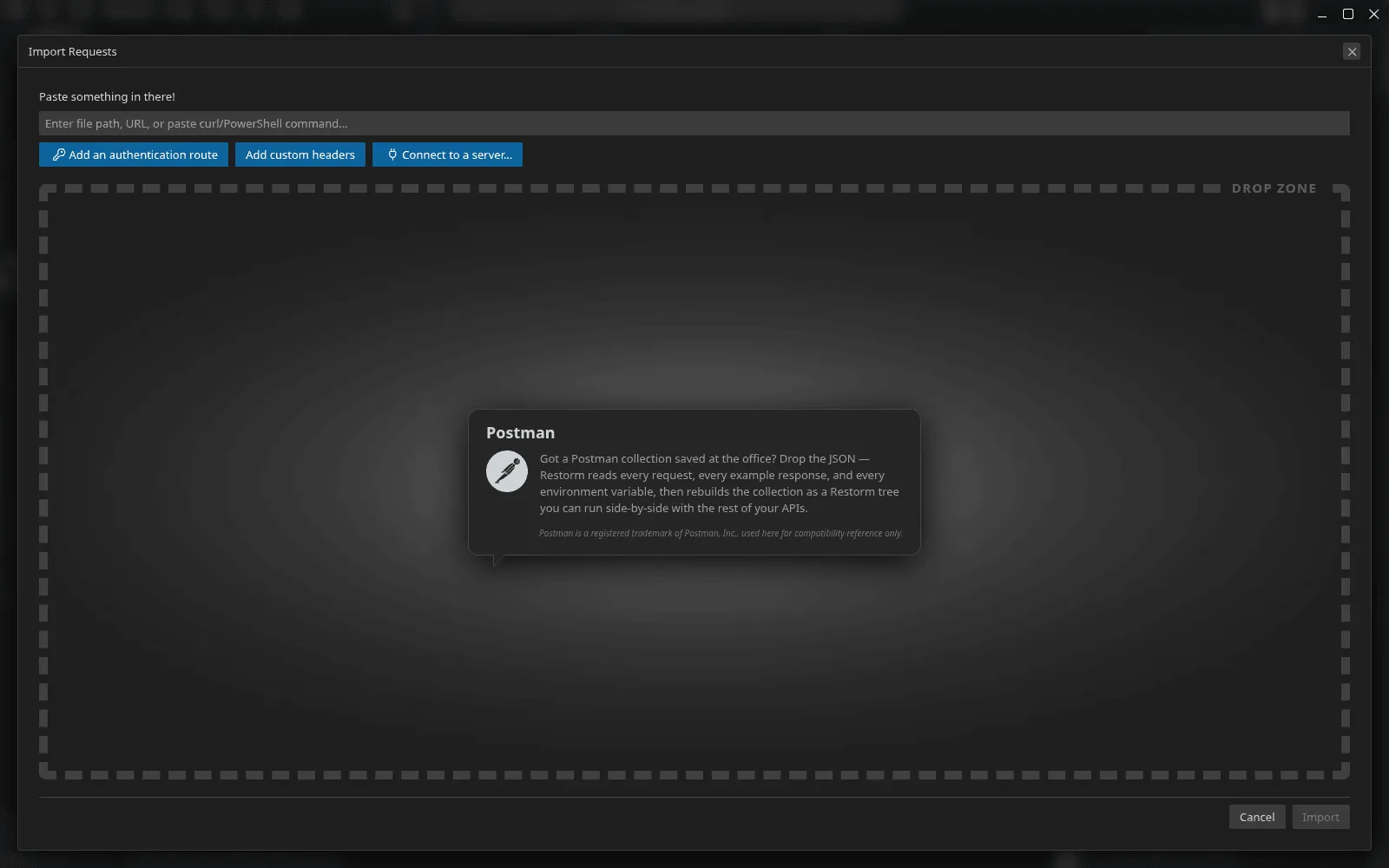
How to import
Section titled “How to import”File ▸ Import (Ctrl+I) accepts:
- a file from disk;
- a URL — handy for a
swagger.jsonor a$metadatadocument served online; - pasted content — this is how you turn a
curlcommand into a request.
Restorm detects the format on its own: first from the file’s extension, then by analysing the content. There is nothing for you to choose.
The formats
Section titled “The formats”API specifications
Section titled “API specifications”| Format | Page |
|---|---|
| OpenAPI 3.x and Swagger 2.0 | OpenAPI / Swagger |
| GraphQL schema (SDL) | GraphQL |
.proto files and gRPC reflection | gRPC |
| WSDL | SOAP / WSDL |
| AsyncAPI | AsyncAPI |
| OData EDMX / CSDL | OData |
| OpenRPC | OpenRPC |
| tRPC schema | tRPC |
| Smithy | Smithy |
| TypeSpec | TypeSpec |
| RAML | RAML |
| WADL | WADL |
| Thrift | Thrift |
| API Blueprint | API Blueprint |
Other clients’ collections
Section titled “Other clients’ collections”| Format | Page |
|---|---|
| Postman | Postman |
| Insomnia | Insomnia |
| Bruno | Bruno |
| Thunder Client | Thunder Client |
| Paw / RapidAPI | Paw |
| HTTPie | HTTPie |
VS Code REST Client (.http) | REST Client |
Captures and command lines
Section titled “Captures and command lines”| Format | Page |
|---|---|
| HAR (browser capture) | HAR |
curl commands | cURL |
Invoke-RestMethod / Invoke-WebRequest | PowerShell |
What you get
Section titled “What you get”Depending on how rich the source format is:
- an environment folder with one or more environments, the base URL extracted from the specification;
- a folder tree — by tag, by service, by resource depending on the format;
- one request per operation, of the type matching the protocol;
- the API documentation attached to the folder: models, descriptions, security schemes, sample responses;
- the specification’s enumerations, reusable as a value type;
- the pre-wired authentication headers with their variables — see Authentication.
After the import, every key / value pair whose value resolves to empty is disabled automatically: your first send therefore does not go out with a swarm of empty headers.
The imported API’s documentation
Section titled “The imported API’s documentation”An import does not only produce requests: it keeps the API’s documentation — descriptions, models, security, examples, enumerations — browsable in the created folder’s Docs tab. See Accessing and updating an imported API’s documentation.
Updating an import
Section titled “Updating an import”Twelve formats can be re-synced: Restorm compares the source’s new version to the existing tree and applies the delta, without losing your edits. See Updating from the source.
What about export?
Section titled “What about export?”Restorm generates code snippets for every request, in every language relevant to its protocol. See Code export.