
SSE (Server-Sent Events)
Server-Sent Events are a one-way HTTP stream: the server pushes, the client listens. Restorm makes it a request type in its own right.
Right-click in the tree ▸ Add ▸ SSE request.
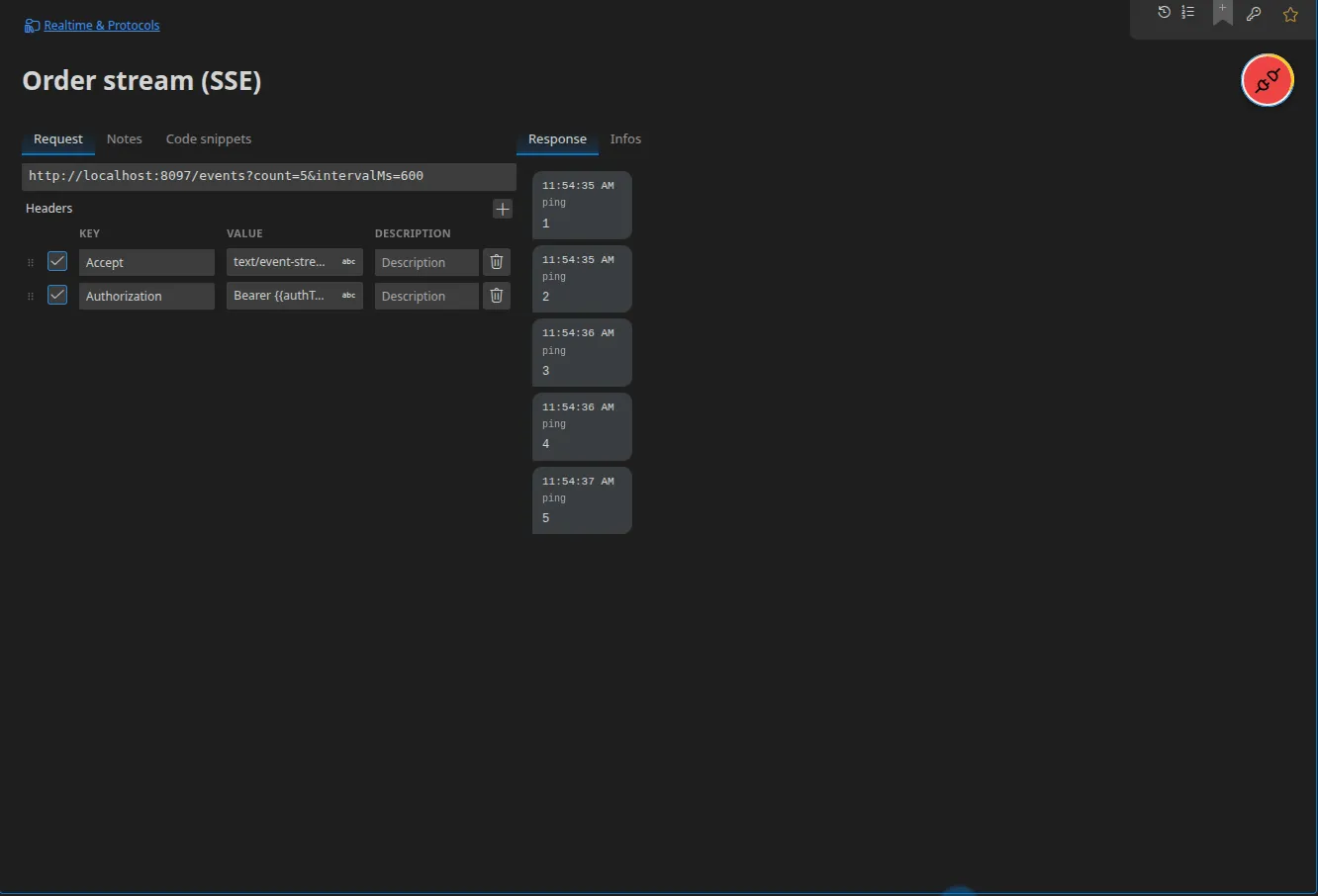
Configuration
Section titled “Configuration”| Field | Role |
|---|---|
| URL | The stream’s endpoint |
| Headers | The opening request’s headers — this is where authentication travels |
| Last event identifier | Seed value for the Last-Event-ID header, sent on the first connection only |
Behaviour
Section titled “Behaviour”Restorm follows the EventSource specification: it parses the event:, data:,
id: and retry: fields, and shows each event received with its timestamp, its
name and its payload — clicking an event unfolds its full content. The identifier
is remembered for reconnection.
If the stream is cut, reconnection automatically re-sends the last identifier
received in Last-Event-ID — which is what lets the server pick up where it left
off.
The stream is receive-only: there is nothing to send once the connection is open.
In a scenario
Section titled “In a scenario”Two actions: SSE connect (connected and message outputs, one emission per
event received) and SSE close. See
Connections and streams.
The usual pattern: open the stream, trigger the business action with an HTTP call,
then check with an assertion that the expected event does indeed arrive on the
message port.
Code snippets
Section titled “Code snippets”Three targets: cURL, the browser’s EventSource, Python (streaming requests).