
HTTP and REST
The most common request type: anything that speaks HTTP, starting with REST APIs.
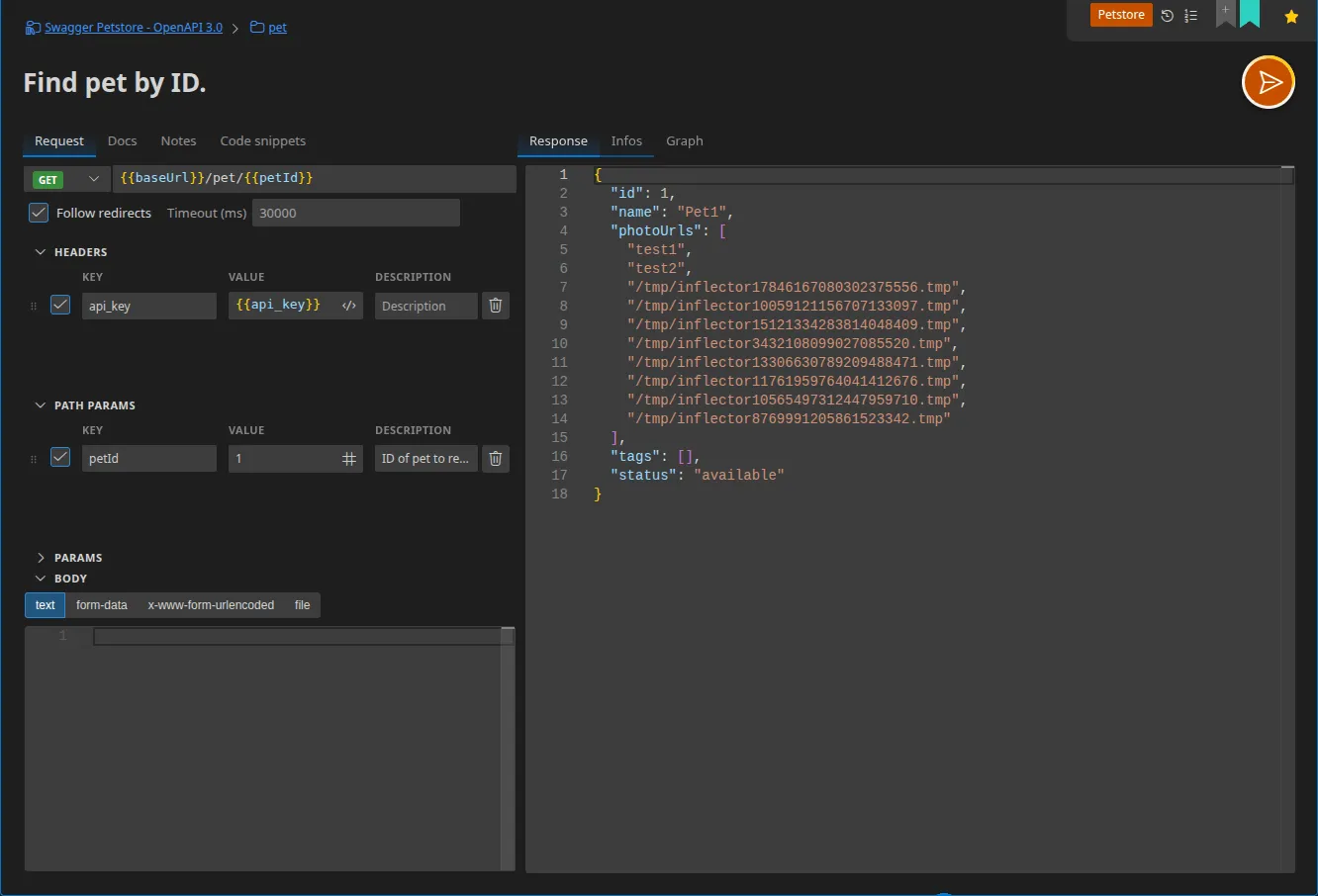
Right-click in the tree ▸ Add ▸ HTTP request.
Methods
Section titled “Methods”GET, POST, PUT, PATCH, DELETE, HEAD, OPTIONS and QUERY.
The URL
Section titled “The URL”The URL accepts {{variables}} anywhere — scheme, host, port, path, query
string. The resolved value is shown under the field.
Three lists complete the URL:
- query parameters (
?key=value); - path parameters, which replace the path’s named segments;
- headers.
Every row has an enable tickbox, a value type and a description.
The body
Section titled “The body”Four families:
| Type | Use |
|---|---|
| Text | JSON, XML, plain text — with syntax highlighting and reformatting |
| File | Sends the contents of a file from disk |
Form (multipart/form-data) | Named fields, with files |
x-www-form-urlencoded | Named fields encoded in the body |
Options
Section titled “Options”- Timeout: in milliseconds, specific to this request; failing that, the global value applies.
- Follow redirects: enabled by default. Turn it off to observe the
3xxitself and itsLocationheader.
The response
Section titled “The response”Status, time, size, headers, and the body rendered according to its content type: collapsible JSON viewer, indented XML, image preview, plain text. The history tab gives you access to previous runs.
Authentication
Section titled “Authentication”Attach an authentication route to the request so that the headers are injected and the token renewed automatically. See Authentication.
Server mode
Section titled “Server mode”Restorm can also host an HTTP server, to test how a client consumes it —
typically your application’s code, which you point at localhost for the
duration of a test.
Add one with Add ▸ HTTP server: it listens on localhost:<port><path> for a
method + path pair and replies with the status, headers and body you configure
there. Other protocols are hosted the same way — see
Server mode and
Mocking an HTTP API.
Code snippets
Section titled “Code snippets”Twenty-four languages and libraries are offered in the Code Snippets tab:
cURL, JavaScript (Fetch, Axios), TypeScript, Python (Requests, http.client,
aiohttp), native Node.js, Go, Rust (reqwest), Java (HttpClient, OkHttp), C#
(HttpClient), PHP (cURL, Guzzle), Ruby (Net::HTTP, Faraday), Swift (URLSession),
Kotlin (OkHttp), Dart, R (httr), PowerShell, Elixir (HTTPoison), Clojure
(clj-http).
Import rather than type
Section titled “Import rather than type”Do you have an OpenAPI specification, a Postman collection, a HAR file or just a
curl command? File ▸ Import rebuilds the tree for you. See
Import & export.