
Socket.IO
Socket.IO is available by choosing the socketio protocol on a
WebSocket request.
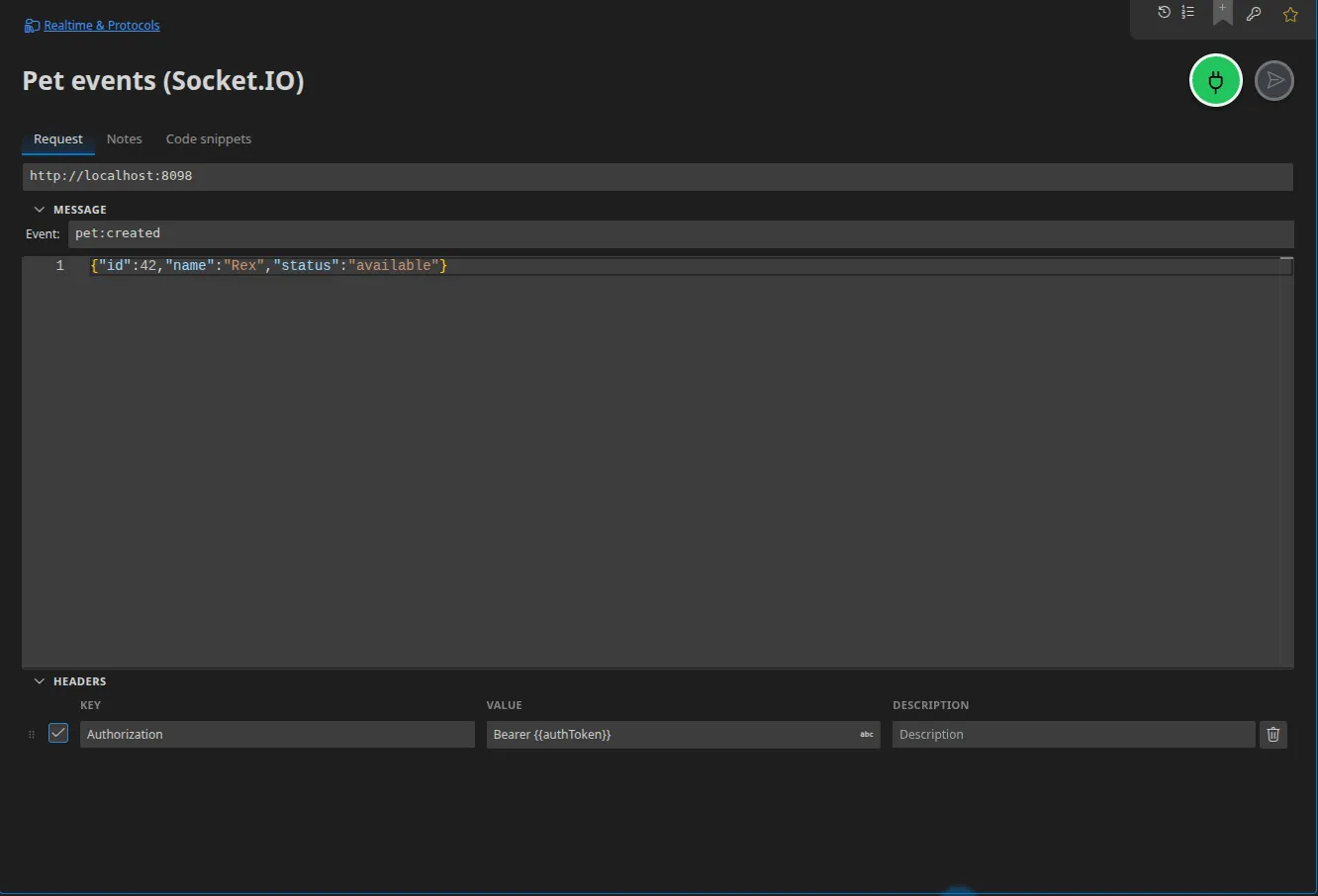
Unlike raw WebSocket, Socket.IO carries named events: it is the event’s name that distinguishes one message from another, not its content.
Configuration
Section titled “Configuration”| Field | Role |
|---|---|
| URL | The Socket.IO server’s URL |
| Event | The name of the event being emitted |
| Message | The event’s payload |
| Headers | The handshake headers |
In a scenario
Section titled “In a scenario”The Socket.IO connect action is the only one whose outputs are configurable: you declare the list of events you care about, and the box then exposes one port per event, plus:
connected— a signal emitted when the connection is established;others— the default port, which receives any event you did not declare.
That is what lets you dispatch cleanly: commande:acceptée on one side,
commande:refusée on the other, without writing a condition.
The Socket.IO send (with channel and payload) and Socket.IO close actions complete the lifecycle. See Connections and streams.
Server mode
Section titled “Server mode”Restorm can host a Socket.IO server, which shares its socket with the other servers on the same port. See Mocking WebSocket, Socket.IO and MQTT.