
Mocking an HTTP API
Right-click a folder ▸ Add ▸ HTTP server.
Configuring
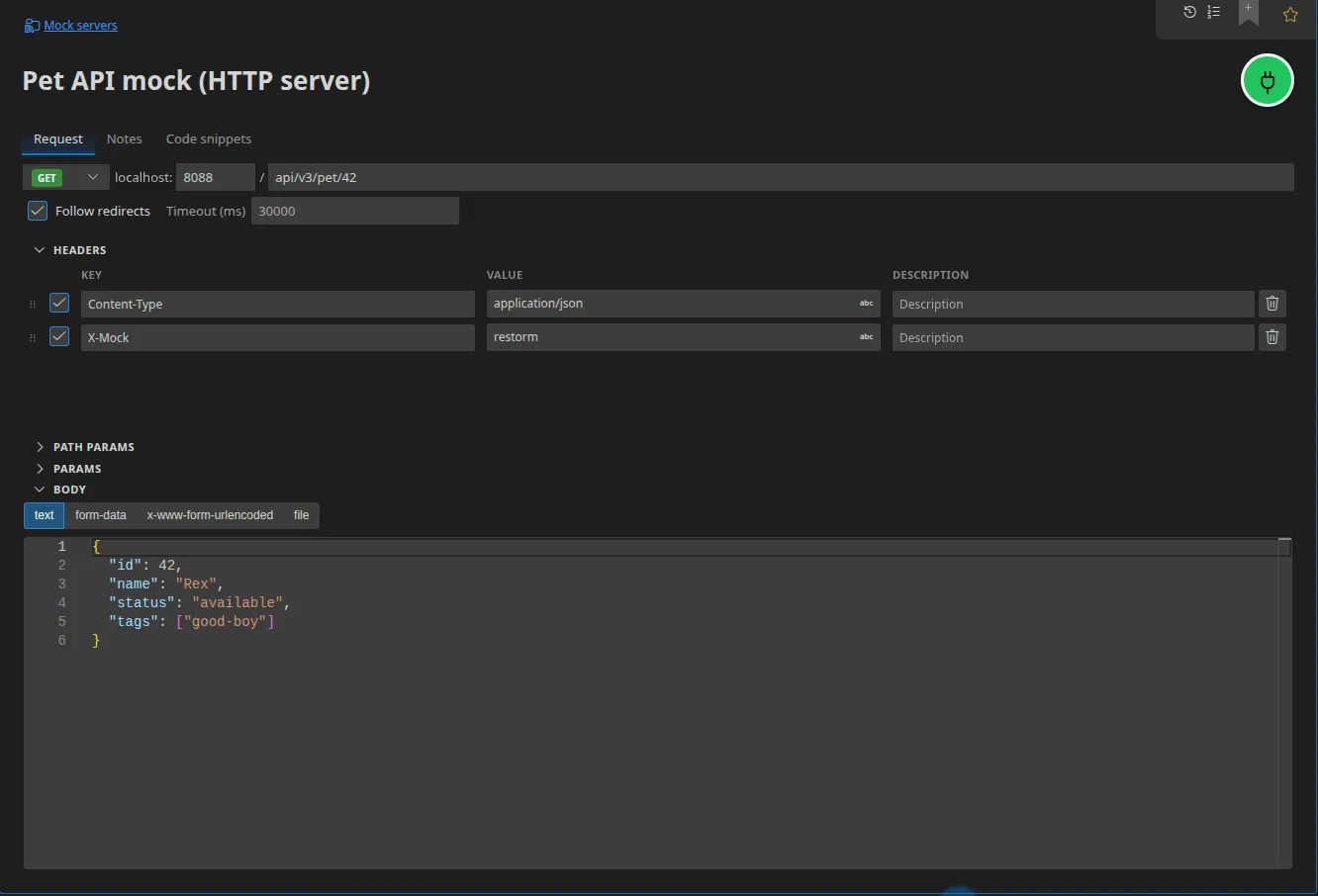
Section titled “Configuring”A server is configured with the same fields as a request — and that is the whole point: the method and the path define the route listened on, while the status, the headers and the body define the response served.
| Field | Role |
|---|---|
| Method | The route’s method |
| Address | localhost:<port><path> — the host is fixed |
| Mock status | The code returned, 200 by default |
| Headers | The response’s headers |
| Body | The response’s body |
Routing
Section titled “Routing”A route is a method + path pair. Matching is on the exact path, and the query string is ignored. Any call arriving on the port without matching a route gets a 404.
Two routes only collide if they share the same method, the same path and the same port. You can therefore create one server request per route and start them all.
GET localhost:8080/clients → 200, liste de clientsGET localhost:8080/clients/42 → 200, un clientPOST localhost:8080/clients → 201, en-tête LocationGET localhost:8080/clients/999 → 404 (aucune route : réponse par défaut)Templates
Section titled “Templates”The headers and the body are resolved on every inbound call. A body containing
{{maintenant}} or {{compteur}} therefore changes from one call to the next if
the variable changes.
A tip: this lets you drive the server’s behaviour while it is running — change an environment variable’s value and the next call gets a different response, with no restart.
Port sharing
Section titled “Port sharing”A mock HTTP server and a WebSocket or Socket.IO server can listen on the same port: Restorm dispatches ordinary requests to the HTTP routes and upgrade requests to the real-time server.
In a scenario
Section titled “In a scenario”The HTTP server action hosts the route for the duration of the scenario and
emits a served event — carrying { request, response } — per call received.
That is how you test a webhook:
Serveur HTTP ──connected──► Requête HTTP « déclencher le webhook » └────────served──────► Assert sur request.body puis ──► Fermeture serveur HTTPSee Hosted servers.